Gosling Fuels A “Driven” Success

Every few years there are films that introduce new styles of direction and narrative to a tired movie industry. These movies challenge the status quo and blaze the way for new kinds of movies. In the past these were movies like The Coen Brothers’ Fargo or Quentin Tarantino’s Pulp Fiction. I believe Drive is this kind of movie. With staggering direction and breathtaking style, Drive is a new classic, for a new generation of moviegoers.
Drive tells the story of an unnamed driver (Gosling), who is a Hollywood stunt driver by day and a getaway artist by night. The film establishes early that the driver is a loner and is really a man of few words. Gosling has an associate named Shannon (Bryan Craston), who helps scope out jobs for Gosling, along with employing him at a car shop. Eventually Gosling meets Irene (Carey Mulligan) and begins to fall for her, despite the fact she has a husband (Oscar Isaac) in jail. All hell breaks loose once the husband comes back, and Gosling suddenly finds himself on the run from some of Los Angeles’ most dangerous criminals.
 |
| Gosling in the opening of Drive |
 |
| Director Refn with Gosling in Drive |
Gosling’s performance in Drive is superb. His style of acting is so spare and yet so absorbing that it brings to mind Martin Sheen’s performance in Terrence Malick’s Badlands. There are many scenes where Gosling may say nothing at all, and instead rely on visual cues to evoke emotion. This seems like a homage to Clint Eastwood’s character “The Man With No Name” in Sergio Leoni’s spaghetti westerns; Gosling’s reliance on silent emotion parallels Eastwood’s character in these earlier westerns. Another interesting aspect of Gosling’s character is the more he has to speak, the more violence he ends up committing. In the few scenes where his character has extended dialogue, Gosling uses some of the most brutal violence imaginable.
In addition to Gosling, Drive gets dynamite performances from Craston and Ron Perlman, who play Gosling’s partner and main antagonist, respectively. Perlman brings his typical scowl to his role as a gangster, but owns it from start to finish. Craston plays the usual role of sidekick to Gosling’s stoic hero, but he brings fresh energy to this role and helps develop our hero more.
Another excellent attribute of Drive is its use of space. There are very few sections of extended dialogue in the film, and director Nicholas Winding Refn relies on sound and expression to evoke the emotion on screen. The sights and colors are more than enough to capture your attention; so Refn doesn’t clutter these scenes with superfluous dialogue. Instead Refn allows these scenes to grow on their own, thus establishing narrative space. In many ways the narrative plays out like a flash fiction, instead of using extended scenes to develop the setting, characters, etc. The plot uses abbreviated scenes and quick bursts of dialogue to build its narrative style. This organic suspense grows and grows, until Refn decides to punctuate it with a violent apex at the perfect moment.
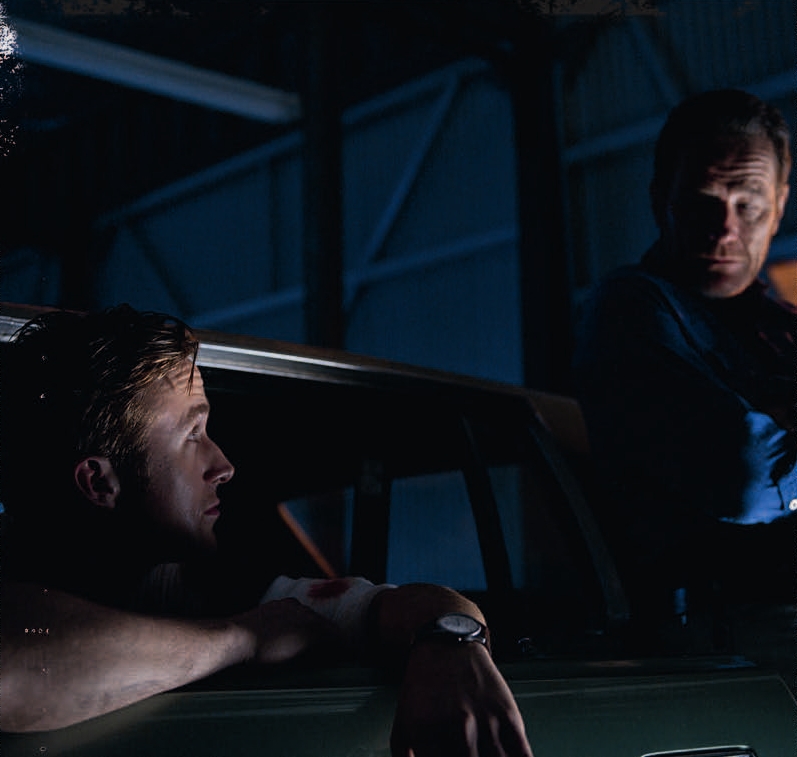 |
| Gosling and Bryan Cranston in Drive |
With Drive, Refn has established himself as a major director with this film, a rare artist who can mix indie elements with a larger-budgeted scope. Drive should become Refn’s Pulp Fiction, or Fargo: a movie that brings a distinct style to the table, and trumpets the arrival of a new directorial force in film.
Drive receives a 9/10

No comments:
Post a Comment